Psychohistory with Modern Science
Asimov imagined a mathematics capable of steering civilization. Modern social science has built fragments of it, and discovered why the whole may be impossible.
›Contents
Minor spoilers for Isaac Asimov's Foundation trilogy.
Imagine being arrested not for a crime, but for a calculation.
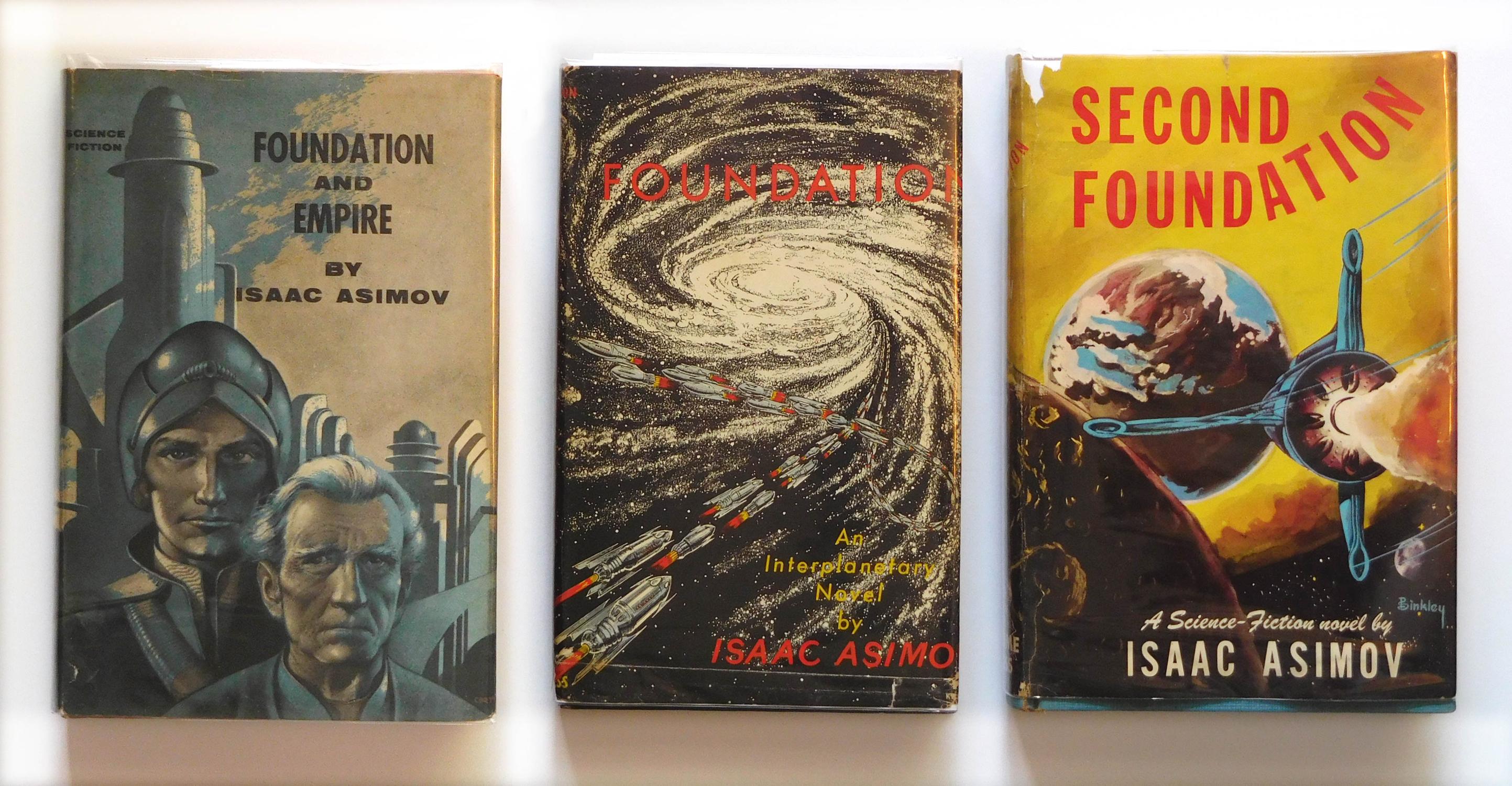
Hari Seldon, the mathematician at the centre of Isaac Asimov's Foundation, has proved that the Galactic Empire will fall. Its rulers still command millions of worlds and its institutions look permanent. Yet Seldon's equations say that collapse is already encoded in the behaviour of the civilization itself. Thirty thousand years of disorder will follow, unless a carefully designed intervention compresses the interregnum to one thousand years.
Seldon calls his science psychohistory: a combination of history, sociology and statistical mathematics capable of predicting the behaviour of very large populations, while retaining individual ignorance, like statistical mechanics, which describes the pressure of a gas without tracking every molecule, psychohistory makes individuals disappear into the crowd.
Two conditions make this possible. The population must be sufficiently large (Law of Large Numbers), and it must not know the prediction (no interference). Even then, psychohistory is vulnerable to the unprecedented. In Foundation and Empire, the Mule (an individual with abilities Seldon's model could not anticipate) acts as a Black Swan in Taleb's sence and pushes history off the event distribution.
Psychohistory remains still nowadays a powerful idea, and it raises the question of whether individual uncertainty can coexist with social predictability.
Modern research instead points to mathematical regularities, such as local rules capable of generating remarkably stable collective patterns, rather than universally valid laws of history. These regularities remain highly contingent.
Psychohistory does not exist. Fragments of it do.
What would a mathematical social rule look like?
There is no single academic field called “social rule science.” Related works are distributed across mathematical sociology, computational social science, network science, game theory, and agent-based modelling.
These disciplines do not usually search for universally valid rules such as “empires collapse after X number of years”, rather they construct smaller and more testable rules. A person occupies a state, where it can cooperate or defect, protest or staying home, holding one opinion or another, and so on. Like in a graph these actions affect neighbouring nodes, creating incentives and consequences.
A generic version looks like this:
The state of person tomorrow depends on their state today (Markov rule), their social environment, their incentives and some irreducible uncertainty. Create a graph of people, such as in networks, repeat the rule, and a macroscopic pattern may emerge.
Here are some examples.
1. Thresholds and social tipping
In Mark Granovetter's threshold model, each person has a threshold . They join a behaviour when the share of others already participating exceeds that threshold:
The model has since been extended into explicit network models of social tipping. A 2020 study, for example, showed how broad population-level thresholds can emerge from local interactions and how tipping points can display both sudden transitions and hysteresis: removing the original trigger does not necessarily return society to its previous state. The same family of models has been applied to protests, voting, migration, innovation and behavioural change (Wiedermann et al., 2020).
The equation does not predict the next revolution. It defines a mechanism through which one can occur.
2. Mild preferences, extreme outcome
Thomas Schelling's segregation model begins with an equally modest rule. Imagine two kinds of households distributed across a grid. Each household is willing to live in a mixed neighbourhood but moves when too few nearby households are similar to it. Formally, if is the share of similar neighbours, household moves when , where is its tolerance threshold.
The result is unsettling: even relatively tolerant individual preferences can produce highly segregated neighbourhoods. The collective outcome is more extreme than the intention of almost any participant (Schelling, 1971).
3. Cooperation as an evolving strategy
Evolutionary game theory treats behaviours as strategies whose frequency changes with their relative success. The replicator equation is:
where:
- is the population share using strategy
- is its rate of change
- is the expected payoff of strategy s
- is the population average payoff.
For a game with the payoff matrix , then is: .
If cooperation performs better than the population average, it spreads; if worse, it contracts. Network position, reputation, repeated encounters and punishment can all alter the payoffs. Norms then need not be imposed by a central authority. They may emerge, stabilize or collapse through repeated local interaction.
None of the previous models is nearly close to psychohistory, however they demonstrate its basic intuition: simple rules at individuals level can create order at a population level.
Measuring behaviours
Asimov wrote before smartphones, social media and the continuous recording of human activity. Today, digital traces allow researchers to observe movement, communication, consumption and social interaction at a scale earlier social scientists could not approach. This helped establish computational social science as a distinct research programme (Lazer et al., 2009).
Some findings appear strikingly "Seldonian". Using anonymized mobile-phone trajectories, Chaoming Song and colleagues estimated an average 93 percent upper bound on the predictability of human mobility. The important phrase is upper bound: they measured how predictable movement (from home to work/supermarket/etc.) could potentially be from the regularity of past trajectories. The result showed that even with free movement substantial routine and predictability exist (Song et al., 2010).
Network experiments have also shown that social structure changes how behaviours spread. Damon Centola found that a health behaviour diffused more effectively through clustered networks (mutually connected people), where people received reinforcement from multiple contacts, than through random networks rich in distant connections (acquaintances) (Centola, 2010).
Current work is making the mathematics more realistic. Traditional networks reduce society to pairwise links: Alice influences Bob, and Bob influences Carla. But much of social life occurs in groups, families, teams, committees, chats and crowds. Higher-order network models represent these group interactions directly through hypergraphs and related structures. A 2025 study argues that doing so reveals mechanisms of group formation, contagion, cooperation and moral behaviour that pairwise models can miss (Battiston et al., 2025). More recent work has started deriving conditions under which contagion and opinion dynamics can, or cannot, be translated between pairwise and higher-order representations (Xie et al., 2026).
This is real progress, while still a long way from forecasting the collapse of an empire.
The wall between patterns and predictions
The strongest evidence against easy psychohistory does not come from philosophy. It comes from prediction itself.
In the Fragile Families Challenge, 160 research teams used a rich longitudinal dataset and modern machine-learning methods to predict six outcomes in the lives of children and families. Despite the number of variables, the quality of the data and the diversity of techniques, the best predictions were not very accurate and were only slightly better than a simple benchmark. Which family was being predicted mattered more to the error than which sophisticated method was used (Salganik et al., 2020).
Why then can a model estimate regularity in human movement yet struggle with life outcomes? Because “human behaviour” is not one prediction problem. Tomorrow's location is constrained by home, work and physical distance. A life trajectory unfolds through relationships, institutions, chance events and choices that change one another over years. Predictability depends on the target, time horizon, available information and stability of the environment.
Five obstacles separate modern social modelling from Seldon's Plan.
-
Social rules are conditional A model calibrated on one platform, country or decade may fail in another. Human systems change throughout time.
-
Rare events can dominate history A model can perform well most of the times, yet fail to forecast the black swan that change completely the course of history. The Mule is not simply an unpredictable person, he reflects an error in the model.
-
Errors compounds Psychohistory extends it across centuries, where the uncertainty and computational errors compounds.
-
Prediction and Explanation are different goals A system may forecast an outcome without identifying the mechanism that produced it, while, conversely, a clean causal explanation may have little forecasting power. Having both, is rather difficult.
-
Reflexivity Social prediction can change the society it is trying to predict. A forecast of a bank run may help cause one. A crime model changes where police are sent and therefore what crime is observed. Machine-learning researchers formalize this as performative prediction: deploying model parameters changes the future data distribution from a fixed into (Perdomo et al., 2020).
This last is a clear obstacle in Seldon's plan, since the population must remain unaware. Someway, Seldon understood that a forecast is not always a camera pointed at the future. Sometimes it is a hand pushing it, and used this at its own advantage.
Prediction without understanding
This distinction leads to a broader conflict between rule-based and empirical approaches.
A rule-based model begins with a proposed set or rules and a precise structure that bounds available actions. An empirical model begins with data and asks which pattern predicts well, even if the resulting mechanism is difficult to interpret. Statistician Leo Breiman described these as two modelling cultures: one concerned with an interpretable data-generating process, the other with predictive accuracy (Breiman, 2001).
In finance and trading, the empirical culture has become especially powerful. Machine-learning systems can exploit patterns too numerous, unstable or entangled for a human theory. With AI, we may increasingly know that a signal works without knowing why it works.
Hopefully, we will stop before reaching Hyperion’s Farcaster stage: everyone uses it, only the AI knows how it works, and nobody dares ask what happens if it breaks.
The comfort of a plan
Psychohistory is also part of a much older human desire: to believe that apparent disorder is being observed, understood and directed from above.
Science fiction repeatedly turns this desire into institutions. Asimov gives us Seldon and the hidden guardians of his Plan. Dune gives us the Bene Gesserit, shaping bloodlines and politics across generations. Hyperion gives us intelligences that simulate futures while pursuing plans invisible to humanity. Traditions and beliefs often place history within providence, destiny or a larger moral order.
These stories understand something uncomfortable: a plan is reassuring only while we trust the planner.
They also illustrate the difference between something being deterministic and predictable. A system can follow precise physical rules and still be practically impossible to forecast because it is chaotic, computationally intractable or too sensitive to initial conditions. The three-body problem is the classic image: the laws are known, yet no general closed-form solution tells us every future configuration.
Formal logic imposes a different kind of humility. Axioms are starting assumptions, not propositions proved from nowhere. This does not prove that society is "unknowable", but it makes unreachable the dream of a single self-contained framework that proves every truth, including itself.
Conclusion
Asimov's strongest insight was that large populations have a structure invisible at the level of one life. His idea was that this structures could become a stable plan. We may never build psychohistory, but its pursuit is teaching us the limits of prediction, explanation and control.
References
- Isaac Asimov, Foundation, Foundation and Empire and Second Foundation.
- David Lazer et al., “Computational Social Science”, Science (2009).
- Marc Wiedermann et al., “A Network-Based Microfoundation of Granovetter's Threshold Model for Social Tipping”, Scientific Reports (2020).
- Thomas C. Schelling, “Dynamic Models of Segregation”, Journal of Mathematical Sociology (1971).
- Chaoming Song et al., “Limits of Predictability in Human Mobility”, Science (2010).
- Matthew J. Salganik et al., “Measuring the Predictability of Life Outcomes with a Scientific Mass Collaboration”, PNAS (2020).
- Juan C. Perdomo et al., “Performative Prediction”, Proceedings of ICML (2020).
- Federico Battiston et al., “Higher-Order Interactions Shape Collective Human Behaviour”, Nature Human Behaviour (2025).
- Ming Xie et al., “Transformability of Dynamics on Higher-Order Networks”, Communications Physics (2026).